
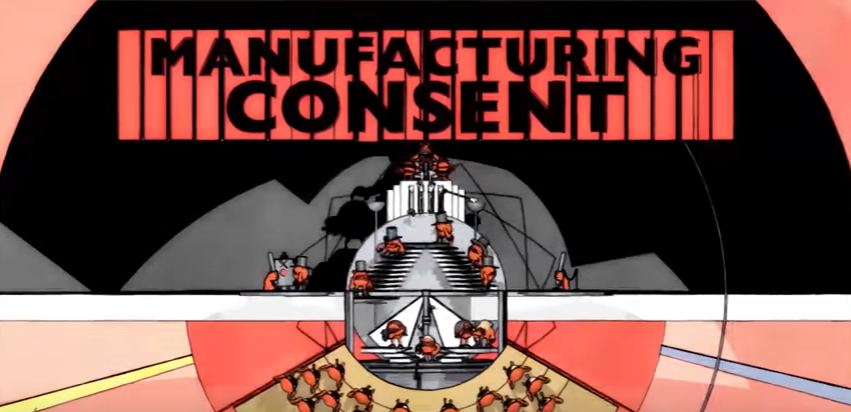
Edward S. Herman and Noam Chomsky’s Manufacturing Consent: The Political Economy of Mass Media (1988) is one of the key texts in understanding how media and power function in society. While the text is over 35 years old, the main concepts still apply and make sense in modern day context. Manufacturing Consent: The Political Economy of Mass Media (1988) was also the text that introduced The Propaganda Model and how it works. While at the time Herman and Chomsky wrote about how anti-communism goes through the propaganda model and how that was the main point being pushed by the media, this has since been adapted to the “War on Terror” movement. The process of the five step model is mostly the same just with an initiative of pushing whatever fear is most socially relevant at the time.
Herman and Chomsky’s propaganda model explains how raw information is changed and turned into what is actually reported by news. Herman and Chomsky described a five step process that the information goes through: financial ownership, advertising, sourcing, flak, and that socially relevant fear. The Cambridge Dictionary defines Propaganda as “information, ideas, opinions, or images, often only giving one part of an argument, that are broadcast, published, or in some other way spread with the intention of influencing people’s opinions.” This definition is relevant when looking at Herman and Chomsky’s ideas because of certain criticisms their ideas have received. Society wants to disagree with what they are saying because no one wants to believe they are being influenced. Something pointed out when discussing the Propaganda Model is how the filtered news should not be considered propaganda. This may be true when one believes that the only form of propaganda is the famous examples, such as war time propaganda, when in fact that is just one example of propaganda. Other examples are not as obvious. Wartime Propaganda, especially looking back on it with full knowledge of the conflict and both sides, is very easy to understand and to pronounce as biased. For example, when looking at propaganda created by the Nazis to influence Germans to think of Jewish individuals as “the other” rather than German citizens, it is very easy to point out stereotypes being pushed or complete lies being presented as truths. Since images such as these are so well known, that is what most individuals imagine when they think of propaganda.
However, going back to the definition from The Cambridge Dictionary, propaganda is any form of information that is only giving one part of an argument. Since the whole concept is built on individuals receiving information without the knowledge that there are other sides of the story, it can be very easy to accept what is being told as the whole truth. News sources have spent years building their reputations as reliable and trusted sources. If the news sources have never done anything publicly to disavow the public’s trust, there is no reason for consumers of news to believe that they are being told anything other than the whole truth.
Sources
- Yufeng Ni. (2023). Analyzing the Narrative Framing Pitfalls of Social Media Based on Propaganda Model. [Online]. researchgate.net. Last Updated: May. Available at: https://www.researchgate.net/publication/370705033_Analyzing_the_Narrative_Framing_Pitfalls_of_Socia [Accessed 14 October 2025].
- John Corner. (2003). Mediated politics, promotional culture and the idea of `propaganda’. [Online]. mcs.sagepub.com. Available at: http://www.johncorner.com/wp-content/uploads/2014/08/mediated_politics_and_propaganda.pdf [Accessed 14 October 2025].


This article very clearly and relevantly explains Herman and Chomsky’s Propaganda Model, particularly in showing how such a theory of the late 1980s applies to modern media environments. I appreciate how it first highlights key filters like ownership, advertising, sourcing, flak, and dominant ideologies, and then connects those to current fear-driven narratives, such as the “War on Terror.” The distinction that this article makes between obvious, historical propaganda-like wartime posters-and the everyday, subtle forms embedded within sources of news we trust-is so important. For many, propaganda must be extreme or visually dramatic; but it’s an important reminder that sometimes it can just be incomplete information. All in all, this is a strong piece that encourages readers to question how information is shaped before it reaches the public and why media literacy remains essential today.
I liked how you pointed out that propaganda is about just giving one side of the story which means almost any form of media can be propaganda. That made me wonder what it would be like if media like the news or political commentators or even those alpha male podcasts were forced to give at least some energy to the other side sort of like a argumentative essay. I think it’d really help in maybe making people more curious and in turn more willing in to doing their own research in a “oh I wonder why the other side thinks that” way instead of just listening to solely one source.
Hey Caleigh,
Thank you for your blog post, I found it very well-articulated and interesting to read. You managed to clearly grasp and convey the concept of the propaganda model. It is interesting how we associate the word “propaganda” with information that is bluntly wrongful neglecting to remember that propaganda can actually mean shedding light only on a certain area of a topic and keeping the other side of it hidden. This is crucial to comprehend when participating in online conversations and reading new articles. There are so many seamless ways of spreading propaganda online which makes source evaluation so necessary. It is also important to note that propaganda can often be very emotive making it harder to separate from truthful information.
In conclusion, your blog was informative and relevant to contemporary media studies. As a reader, it made me ponder on what shapes and forms propaganda can be seamlessly woven into.
This is a fantastic explanation of a very important idea. You’ve made Chomsky and Herman’s “Propaganda Model” easy to understand, and you’ve convincingly argued why it still matters today. Your modern update is perfect-Connecting the “anti-communism” filter to the modern “War on Terror” is a brilliant and accurate way to show the model is still powerful. This is the strongest part of your analysis.
Also, you tackled a key criticism head-on. Your point about people not wanting to believe they are being influenced is so true. It explains why the theory is often dismissed. The Nazi propaganda example is effective. Using a clear, historical example helps readers understand what “obvious” propaganda looks like, which makes your next point about subtle propaganda even stronger. Overall, this is a really strong piece of writing. You have clearly understood the Propaganda Model and are using it to think critically about the media today.