
Being online, I often see interactions that go roughly as follows:
A video of a person in their teens-30s complaining about the housing economy and how hard it is to afford to live
An older person, 50s+ saying that the young person would not struggle if they cut out costs, often specifying cutting out $5 coffees.
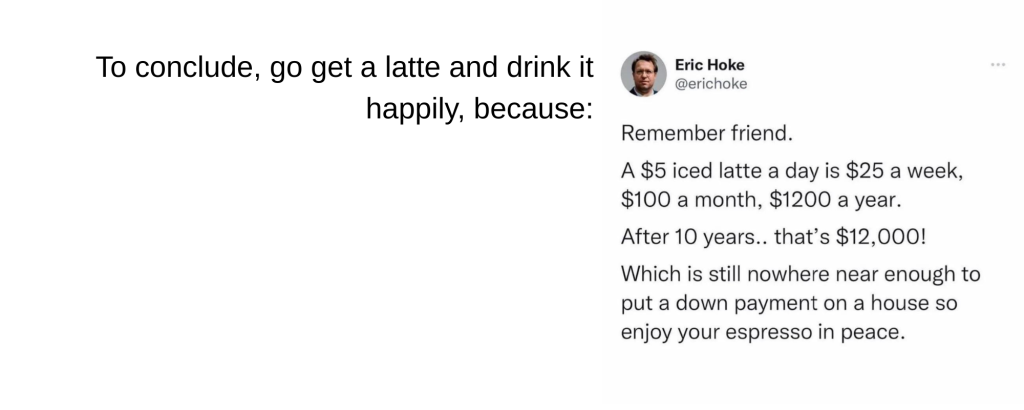
This is an interesting conversation to have because the implication that not buying a $5 coffee will allow a person to save enough money to buy a home or be completely financially comfortable is unrealistic and, frankly, ridiculous. Very few people are purchasing coffees out everyday, and even if they are, the money saved is not nearly enough for a home.
Here’s the thing: we cannot blame the inability to afford a home on something of such low cost and doing so is a form of manufactured consent. To understand why, the concept of manufactured consent must first be understood. The phrase coined by Chomsky and Herman refers to the propaganda pushed to citizens in order to make them complicit in the government’s views and choices which negatively affect them. The economy is entirely dependent on the government. Therefore, when the government makes a decision (typically starting or supporting a war) that increases prices, they work to convince their citizens that it is the fault of the person, not the power. Today, this can be seen through the idea of the “grind mindset” — the act of working hard, making sacrifices such as forgoing sleep and hobbies in order to work even more to afford luxuries or simply living.
As we know, the government controls the media. Chomsky and Herman’s propaganda model for manufactured consent contains five key aspects: “(1) the size, concentrated ownership, owner wealth, and profit-orientation of dominant mass-media firms; (2) advertising as the primary income source of the mass media; (3) the reliance of the media on information provided by the government, business, and ‘experts’ funded and approved by these primary sources and agents of power; (4) ‘flak’ as means of disciplining the media; and (5) ‘anticommunism’ as a national religion and control mechanism” (Herman and Chomsky, p.1-35). All media is government controlled in one way or another because the government depends on the media to advertise social/political issues as a fault of the people. As seen with the latte debate, the government pushes media that forces the average person to consent with government ideologies of working a lot and spending very little.
If the powers were honest, they would admit that their reckless decision making is what has put the rest of us into a place where having a roof over our heads and food in our kitchens is an effort. Instead, because they financially benefit from us struggling, they force us to believe that our ‘poor spending habits’ are the reason for our struggles. Media is manufactured in a way to force us to consent to the idea that we must work harder and spend less.
References
Herman, Edward, and Noam Chomsky. “A Propaganda Model.” Manufacturing Consent: The Political Economy of the
Mass Media, Pantheon, 1988, pp. 1–35, https://r4.vlebooks.com/Reader?ean=9781405150309.


What a great everyday example! The “$5 coffee” argument is something everyone has seen online, and framing it as manufactured consent makes the theory feel immediate. I liked how you connected it to the “grind mindset” and the idea of shifting blame from structural problems onto individual spending. Since you list all five of Herman and Chomsky’s filters, it could be even stronger to apply one or two directly to the latte debate. For example, who benefits when advertiser-funded media frame housing costs as a personal-budgeting issue? It might also be worth nuancing the claim that all media is government controlled. Herman and Chomsky focus a lot on corporate ownership and advertising, so market forces, not just the government, play a big role.