
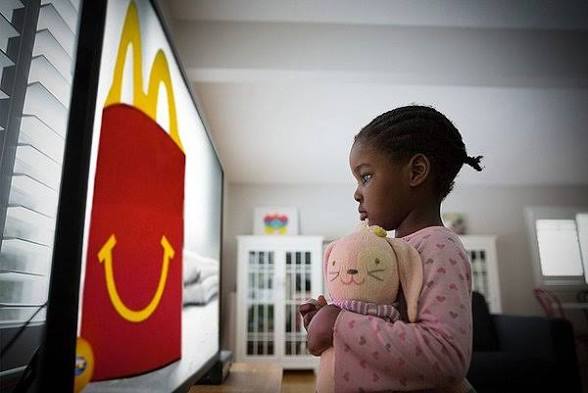
Children’s entertainment has been a distinct feature in human lives for centuries. While in the past it was books and toys that entertained kids, in the 1920s the BBC launched a Children’s Hour, and a decade later, Disney Animation Studios released Snow White and the Seven Dwarfs, which revolutionised children’s entertainment. Now, in the 2020s, children’s entertainment is fully ingrained in mass media, with adverts, shows and movies being directly targeted towards children.
In Manufacturing Consent, Herman and Chomsky argued that advertisers are the real customers of commercial media: we, the audience, are what gets sold (Herman and Chomsky, 1988). With children still socialising into society, this can go a step further. Advertisers don’t just influence what gets made; they influence who the viewers grow to be. A review of nearly 100 studies found that food marketing is associated with children eating more and choosing and preferring advertised foods (Boyland et al., 2022). When children are consistently presented with the same brands, that becomes their “normal”, and they are automatically drawn to it before they can even try or see anything different. So, you get the gist: shows are made to attract audiences that advertisers value, then the ads help create the customers those advertisers want.
Policy makers also seem to recognise the impact advertising has on children. In January 2026, the UK banned adverts promoting less healthy food and drink before 9 pm (Department of Health and Social Care, 2025). The government argues that advertising strongly influences children’s food choices and shapes preferences from an early age. The ban didn’t happen overnight, though, and was delayed due to critics’ claims that lobbying watered it down (GOV.UK, 2024). Whether ads really have such an explicit impact on a child’s socialisation and decision-making is debated. However, if it were just as harmless as mindless ads, would anyone be fighting this hard?
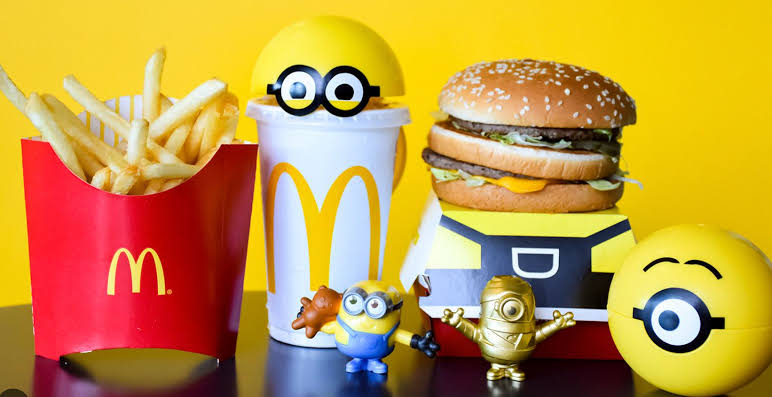
But there is a catch. The ban only targets paid online promotions and TV before 9 pm, leaving much of what children watch in a grey area. Think of influencers, branded games and product placement in videos. If a brand hasn’t directly bought an ad, it can still be woven into the content itself, often from a creator the child has learnt to know and trust.
The ban closes one door, but online, influence can find another. Whether it comes through an advert, a creator’s recommendation or a branded game, the pattern is the same: children learn what to want long before they can question it. Consent isn’t only manufactured through the news. It starts in childhood, one familiar brand at a time.
Bibliography
Boyland, E., McGale, L., Maden, M., Hounsome, J., Boland, A., Angus, K. and Jones, A. (2022). Association of food and nonalcoholic beverage marketing with children and adolescents’ eating behaviors and health. JAMA Pediatrics, [online] 176(7), p.e221037. doi:10.1001/jamapediatrics.2022.1037.
Department of Health and Social Care (2025). Applying the new NPM to advertising and promotions restrictions. [online] GOV.UK. Available at: https://www.gov.uk/government/consultations/applying-the-new-npm-to-advertising-and-promotions-restrictions/applying-the-new-npm-to-advertising-and-promotions-restrictions [Accessed 15 Nov. 2026].
GOV.UK (2024). Restricting advertising of less healthy food or drink on TV and online: Products in scope. [online] GOV.UK. Available at: https://www.gov.uk/government/publications/restricting-advertising-of-less-healthy-food-or-drink-on-tv-and-online-products-in-scope/restricting-advertising-of-less-healthy-food-or-drink-on-tv-and-online-products-in-scope [Accessed 15 Nov. 2026].
Herman, E.S. and Chomsky, N. (1988). Manufacturing consent: The political economy of the mass media. [online] New York: Pantheon Books. Available at: https://www.vlebooks.com/Product/Index/274064?page=0&startBookmarkId=-1 [Accessed 15 Nov. 2026].


