
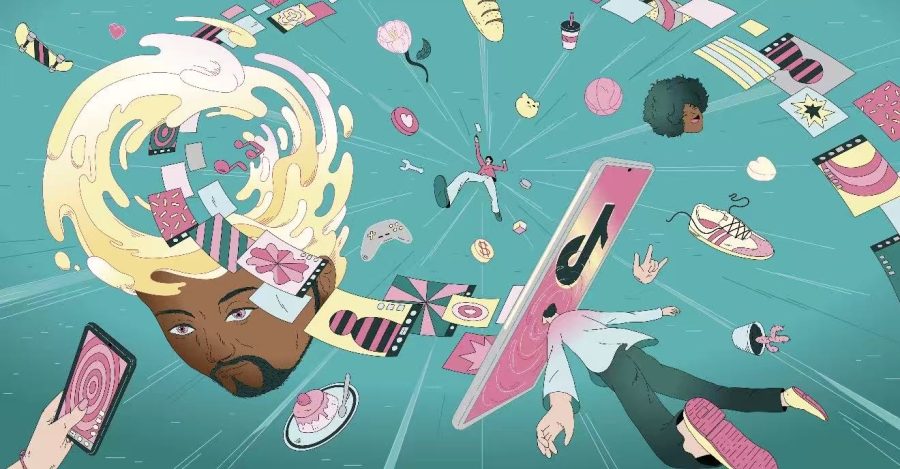
Earlier this year, I realised I knew very little about current‑world affairs. For example, when my younger brother and mother often talked about politics and the economy, I could not keep up with their conversations. I felt anxious and worried, as if I was falling behind social changes and disconnected from the real world. So I tried to reshape my For‑You Page on Douyin, the China‑version of TikTok. I searched for political‑economic videos and followed several well‑known commentators. However,Around two weeks later, my feed reverted to its original state: funny clips, memes, internet slang and various viral trends. My scrolling behaviour has remained unchanged afterwards. This personal story is a small reflective case study to test Adorno and Horkheimer’s idea of “pseudo‑individuality”, and it does not stand for the common experience of all platform users.
Adorno and Horkheimer (1944) argue that under monopoly, “all mass culture is the same”. Culture is produced with the same standardised, profit‑driven methods used for any industrial product (Flynn, 2023). As Zuidervaart (2024) sums up, audiences end up choosing from “pseudo‑individualised options”: they feel they have choices, but there are no real differences.
My For‑You Page promises to be “made for me”. Yet it returned to memes and trends that countless other users also watch. There are changes on the surface, but the same basic formula lies underneath. This is “pseudo‑individuality” in real life. Personalisation works at the level of distribution here: the For‑You Page feels like “mine”, but circulating content depends on what performs well. I cannot see inside the algorithm, so I cannot fully explain why my feed changed back. Still, it is worth noting that light entertainment returned while serious content faded away. When studying heritage‑related content, Paquienseguy and Guo (2025) find that MCN agencies and AI algorithms help creators get the best results while lowering risks. This is much like an industrial production logic. Tinlin (2024) makes related points about aesthetic trends on TikTok: these trends look very personal, yet they follow standard formulas.
Even so, this theory has limits. My effort shows I was not a passive consumer. I noticed gaps in my knowledge and took action, something that Adorno and Horkheimer’s writing hardly considers. However, my attempt did not last long. This suggests platform forces can be stronger than personal will. That said, I cannot rule out the influence of my own viewing habits. Audiences have agency, but platforms set the limits of what this agency can reach.
I therefore think this theory works well for explaining platform logic but is less helpful for understanding audiences. It also needs updating: today’s culture industry runs on data from our own behaviour. My experience reminds me: understanding this pattern does not mean I can escape it. I still scroll the same For‑You Page. Perhaps genuine understanding of the world is more likely to be found outside algorithm‑driven feeds.
Reference:
• Adorno, T. and Horkheimer, M. (1944) ‘The Culture Industry: Enlightenment as Mass Deception’. Available at: https://www.marxists.org/reference/archive/adorno/1944/culture-industry.htm
• Flynn, J. (2023) ‘Critical Theory (Frankfurt School)’, Stanford Encyclopedia of Philosophy. Available at: https://plato.stanford.edu/entries/critical-theory/
• Paquienseguy, F. and Guo, Q. (2025) ‘Douyin and the Digital Spread of Intangible Cultural Heritage: Transforming Cultural Dissemination in the Short Videos Age’, Emerging Media, 3(2), pp. 343–366. Available at: https://doi.org/10.1177/27523543251344976
• Tinlin, R. (2024) ‘The Culture Industry: “Clean Girls,” Coastal Grandmothers, and TikTok Consumerism’, Gnovis Journal, 15 April. Available at: https://gnovisjournal.georgetown.edu/?p=13805
• Zuidervaart, L. (2024) ‘Theodor W. Adorno’, Stanford Encyclopedia of Philosophy. Available at: https://plato.stanford.edu/entries/adorno/


I really like how you use your own Douyin experience to explain “pseudo-individuality”. It makes the theory easy to understand and connects it to everyday life. I just have one small suggestion. One point that could make your argument even stronger is explaining more about how your own viewing habits and the algorithm work together to shape your For-You Page.
👌🫶🫶🥰
Thanks for the suggestion! You’re right, I should have explained this more clearly. My viewing habits, such as what I watch to the end, like, replay or search for, give the algorithm data, which then shows me more similar content, and that shapes what I watch next. So it’s a feedback loop between me and the system, not the algorithm acting alone. That’s also why changing my feed was so hard: even small habits kept sending the same signals.
I found your take on this really interesting because it shows how TikTok can make us feel like we are choosing what we watch, when the algorithm still has a lot of control over what appears on our feed. I especially liked the point about how your feed returned to memes and trends even after you tried to change it. It makes me wonder whether we are actually in control of our interests or if the content we see slowly shapes them for us. Do you think users can genuinely escape this cycle, or will algorithms always influence what we choose to watch?
Thanks for your comment! I think users can partly escape, but never fully. Actively searching, following different creators or resetting recommendations can loosen the cycle, as I tried to do. But the algorithm is still trained to maximise engagement, so it tends to pull us back towards familiar content. So the choice doesn’t disappear, it just stays shaped by the system. That’s what Adorno meant by pseudo-individuality: it feels like our own choice, but the options have already been filtered. Do you think platforms could ever design a feed that really encourages unfamiliar content?
This is a really good commentary on how the algorithm plays into pseudo-indiviuality! I have definitely recognized similar things in my own social media pages. On Instagram I receive different content than I do on TikTok, but political/activist content is a consistent (though small) form of content that I am shown. I have noticed that even when I try to interact with different content on TikTok, it reverts back to the usual videos after a while. Great post!
💕💕