
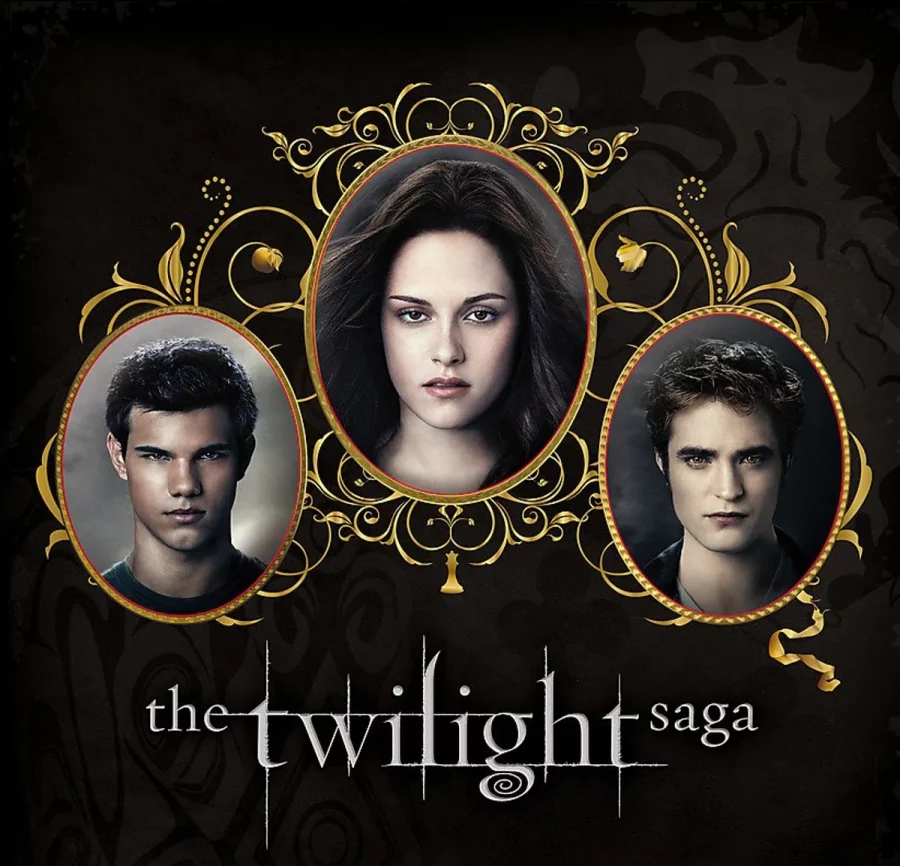

Time and time again, movies and books are published starring a woman who has to choose between two men. Rarely is there a plot involving a woman choosing herself, making something of herself, or having no romantic relations in the first place. Why is it that a female character requires a male character to be a person?
All of this trails right back to the ‘male gaze.’ Coined by Laura Mulvey in her 1973 essay “Visual pleasure and narrative cinema” Mulvey describes the male gaze as the way women are viewed, particularly in Hollywood, through a male lens, often reducing a woman to her looks and/or use for a man. In Twilight, Bella Swan is being pulled between Edward and Jacob, both trying to convince her to choose himself. All of her personhood depends on the men, as she is very rarely without them and arguably has little personality that does not depend on one of them. In the end, Bella chooses Edward, but that choice causes her to sacrifice her life and to be turned into a vampire.
Bella is viewed through a typical male lens. She is beautiful, meek, and dependent on a man to live her life (even if it is an undead one). She constantly needs saving. The first film/book starts with Bella moving in with her father because she feels she is taking too much of her mother’s time that her mother could be spending with her new boyfriend. Immediately, Bella is sacrificing her comfortable life for her mother and a strange man, and her father, Charlie, is there to save her from the discomfort. One of the next scenes is Edward saving Bella from being hit by a car. He physically stops the car and shields her and, in this, both Bella and Edward are projecting the male gaze. Bella is small and in danger, Edward is strong and a protector.
While Bella is largely constructed through an emotional male gaze, further into the series she does become physically constructed the same way. Later on, Bella says she would be willing to give up children, or to adopt, in order to be with Edward as they were not sure if a vampire/human baby would be safe to carry. She becomes pregnant anyway and even though said pregnancy literally kills her, she does not choose to terminate, but to carry on with the pregnancy, causing Edward to have to turn her to once again save her life.
In summary, Bella Swan was created as a plot point in the lives of Jacob and Edward. As silly as the series is, it is also a huge indicator of the male gaze in media. She jumbles her life for a man, is fought over and saved by men, and loses her own life for a man. Bella never does anything for herself and is hardly a character when not supplemented by men, making her the perfect example of the male gaze.
References
Mulvey, L. (1975) ‘Visual pleasure and narrative cinema’, Screen, 16(3), pp. 6-18. Available at: https://doi.org/10.1093/screen/16.3.6 (Accessed: 26 November 2026).


