
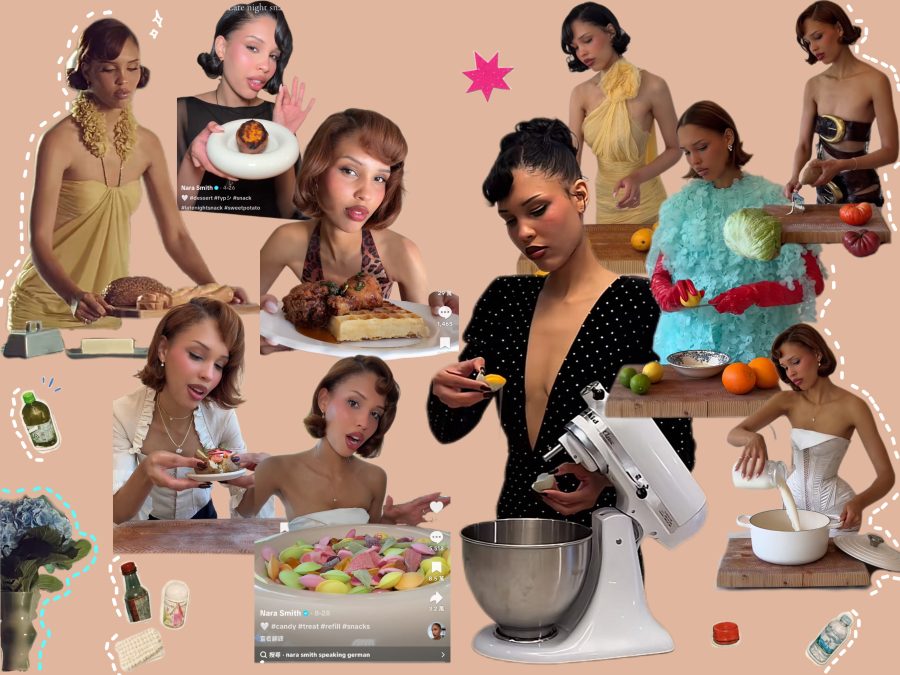
Nowadays, TikTok has become an important digital space for people to show and build their identities. Users can choose what they want to show to the public through videos, photos, texts and other content. Popular lifestyle creator Nara Smith is a good example. She often shares cooking, outfits, beauty and daily life on her account. Although these videos look like real life sharing, the content is carefully selected and presented. Therefore, this blog argues that Nara Smith constructs her digital identity through selective self-presentation, while this identity is also shaped by multiple audiences and social expectations.
Goffman’s (1959) dramaturgical theory provides a useful way to understand this process. He argues that individuals manage the impressions they create through social performances. He divides social life into front stage and backstage. This means people choose what parts of themselves to show to different audiences. In the digital media environment, social media accounts and posted content can serve as a new form of the front stage, as users can choose which aspects of themselves to reveal to others.
Nara Smith’s TikTok content provides a clear example of how digital identity can be constructed through selective self-presentation. In one of her cooking videos, she makes food with a fancy costume and full makeup. This mixes ordinary housework with a carefully styled look. This forms an identity that is feminine, fashionable and related to home life at the same time. Her “solo evening routine” video, covering activities from 5pm to midnight, similarly transforms ordinary daily activities into carefully organised and visually appealing content. Rather than showing every aspect of her life, she selects particular moments that support the image she presents to her audience. Her cooking video connected to Airbnb Experiences further demonstrates how her personal and professional identities can overlap. By presenting herself as someone who cooks and shares her lifestyle, she also creates a recognisable persona that can be connected to commercial opportunities. These examples illustrate Goffman’s (1959) concept of impression management, as Smith’s online presentation involves selecting and organising aspects of herself for an audience. However, this does not necessarily mean that her identity is fake. Instead, her TikTok can be understood as a front stage where particular aspects of her identity are made visible, while other aspects remain outside the performance.
Although Goffman’s theory helps explain how Nara Smith manages her online image, digital identity is not entirely controlled by the individual. Marwick and boyd (2011) describe this as “context collapse”, where different audiences come together in the same online space. For example, her cooking content can present her as a relatable homemaker while also strengthening her professional identity as an influencer. This suggests that her self-presentation must respond to different audience expectations. However, this does not mean her online identity is necessarily fake. She may genuinely enjoy cooking and this lifestyle, while still presenting a carefully selected and managed version of herself on TikTok.
Nara Smith’s TikTok presents a carefully constructed image of her life, rather than a complete picture of who she is. Through selective self-presentation, she continuously constructs her digital identity, which is also shaped by different audiences, platform culture and social expectations. Therefore, digital identity is not simply a reflection of the real self, but an ongoing process of construction and negotiation.
References
Goffman, E. (1959) The Presentation of Self in Everyday Life. Garden City, NY: Doubleday.
Marwick, A.E. and boyd, d. (2011) ‘I tweet honestly, I tweet passionately: Twitter users, context collapse, and the imagined audience’, New Media & Society, 13(1), pp. 114–133.


