
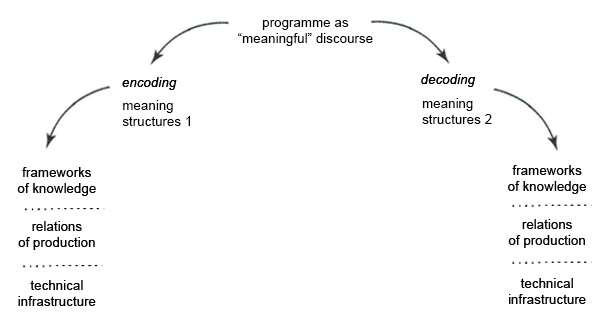
Stuart Hall is a culture theorist who explored and investigated how culture, media, race, class and identity all intersect together. He also explored how different audiences interpret the same message differently compared to other people and how their culture may influence those decisions. (Hall, 1980, Ni, 2024).
The Encoding and Decoding theory proposed by Stuart Hall argues that media producers such as journalists or televisions networks create an overall message, they imbed messages through signs and codes such as images, music, editing to communicate the specific message they want to share. The audience then receive this message and interpret the messages through their own shared experiences and beliefs (Hall, 1980) It is important to know that an active audience challenge this message being sent out whereas for instance a passive audience would take in the message and believe every word being told without questioning it (Lu, 2022). The purpose of these media producers conveying their messages in this way may be because they want the overall public audience to think or feel a certain way, a good example of this is when a Sports wear brand such as Adidas or Nike may use athletes in their advertisements along with uplifting music in order to convey feelings of determination and success.
Stuart Hall mentions three specific reading positions when encoding and decoding messages. These consist of the Dominant reading, the Negotiated reading and the Oppositional reading (Hall, 1980). They each explain how certain audiences fall under these titles and how exactly they take in and interpret the messages given to them by the media producers. The dominant reading is where audiences accept the message being given out to them fully and their own believes align with the ones being conveyed to in the overall message. The Negotiated reading is when an audience may partly agree with some of the points being conveyed in the message since it aligns with their own personal beliefs however they disagree with other things being talked about and may question their overall meaning and purpose. The Oppositional reading is where an audience understands the main message being conveyed but fully disagrees with it, they interpret the message from an oppositional point of view and believe that their own beliefs do not align at all with the overall message that is being conveyed to them (Hall, 1980, Lu, 2021). These are three ways in which the audience may interpret messages given to them by media producers.
Overall, It can be argued that Stuart Hall’s theory still remains relevant to todays society since social media is a key example of this, on these platforms we can clearly denote how the public interpret messages in different ways too and through the comment section under social media posts, we are able to hear their own opinions and beliefs an how that may differ from everyone else who also interpreted the same message. This reinforces the idea that audiences have their own way of taking in messages through the media and it could also argue how they may fall into one of the categories consisting of the Dominant, Negotiated and Oppositional reader (Hall, 1980, Ni, 2024).
References:
Hall, S. (1980) ‘Encoding/decoding’, in Hall, S., Hobson, D., Lowe, A. and Willis, P. (eds.) Culture, Media, Language: Working Papers in Cultural Studies, 1972-79. London: Hutchinson, pp. 128-138.
Lu, Z. (2022) ‘A response to Stuart Hall: Towards a creative decoding’, Signs & Media, 2(1-2), pp. 23-33. https://doi.org/10.1163/25900323-12340014
Ni, Y. (2024) ‘Navigating intercultural communication in the media landscape: Challenging stereotypes and cultivating critical perspectives-Hall model as the framework’, Digital Society, 3, article 36. https://doi.org/10.1007/s44206-024-00126-x


