
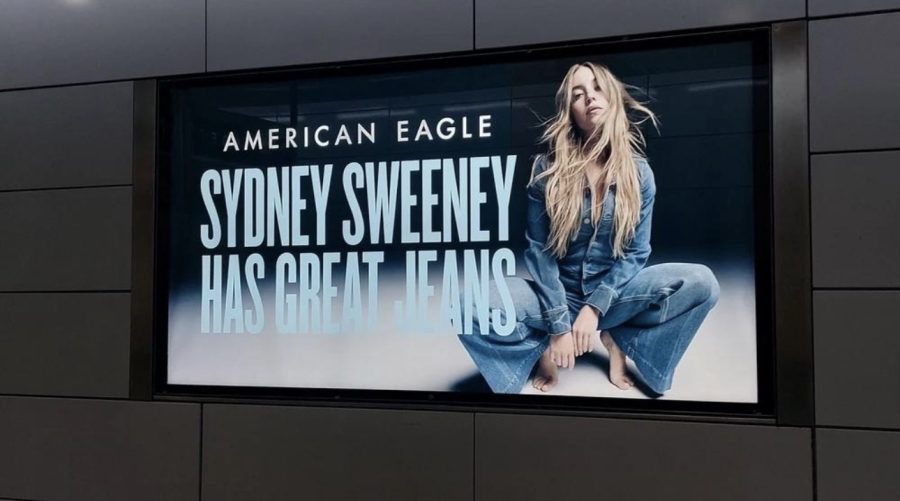
When we look at advertisements, we often focus on the products being promoted. However, the people appearing in these advertisements can also play an important role in attracting our attention. In some cases, women’s appearance becomes just as important as the products themselves. A good example is American Eagle’s 2025 campaign featuring Sydney Sweeney, titled “Sydney Sweeney Has Great Jeans”. Although the advertisement promotes jeans, it also places strong emphasis on Sweeney’s appearance. This raises questions about how women are represented in advertising. In this blog, I will use Laura Mulvey’s Male Gaze Theory to explore this issue.
Laura Mulvey (1975) introduced the concept of the Male Gaze to explain how women are often presented from a heterosexual male perspective in mainstream cinema. Women can be portrayed as objects of visual pleasure rather than as individuals with their own personalities. In this way, women are positioned as people to be looked at. Although Mulvey originally discussed cinema, her theory can also help us to understand how women are represented in advertising.
In this advertisement, Sweeney is positioned on the right side of the image, while the campaign slogan takes up much of the left side. She is crouching with her knees bent and slightly apart, wearing a denim shirt and jeans. This pose makes her outfit clearly visible, but it also draws attention to her overall appearance. The large slogan, “Sydney Sweeney Has Great Jeans”, connects her celebrity image directly with the product. Rather than focusing only on the design or quality of the jeans, the advertisement also uses the visual appeal of its celebrity model to attract attention. Through the Male Gaze, Sweeney’s appearance can be understood as more than simply part of the advertisement. It also becomes a way of attracting viewers and promoting the product.
However, I don’t think the advertisement should be understood as purely objectifying. Sweeney is also presented as a confident and influential celebrity, rather than simply a passive figure. Her involvement in the campaign may suggest female confidence and control over her public image. Nevertheless, this apparent empowerment does not necessarily remove the commercial use of women’s appearance. As discussed in our lecture, women can be sexualised for the sake of sales, while empowerment itself can also become a marketing tool. In this case, female confidence and commercial interests exist together.
To sum up, Mulvey’s Male Gaze Theory remains useful for understanding how women’s appearances are used in advertising. The American Eagle campaign does not simply present Sweeney as a passive object. Instead, it combines her confident image with her physical appearance to promote the product. This shows how modern advertising can use ideas of female confidence alongside traditional beauty expectations to attract consumers.
Reference:
Mulvey, L. (1975) ‘Visual pleasure and narrative cinema’, Screen, 16(3), pp. 6–18.


