
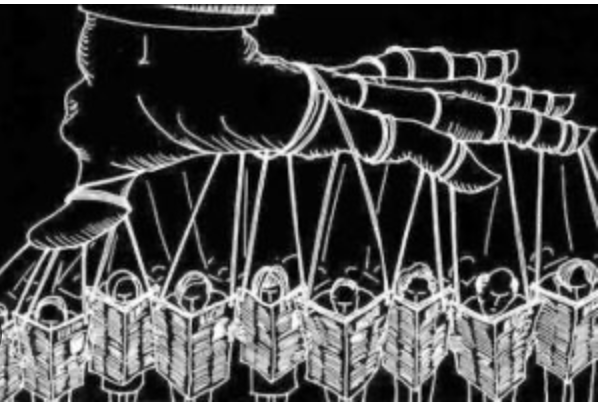
Why is there no revolution if people were dissatisfied with their quality of life and working conditions?
Adorno and Horkheimer argued that the culture industry has submitted to production methods & mass-production sales techniques, thereby leaning away from the commodification of art forms. The penetration of culture by the means and methods of mass production has played a key part in mass entertainment promoting and maintaining the false satisfaction of the masses’ needs.
Adorno argues that Enlightenment ‘is’ deception by using ‘Culture Industry’ because the promise of enlightenment is lost and the ‘reason’ has failed to emancipate without people realising, which prevents
Enlightenment is deception
The culture industry is able to arouse a feeling of well-being that the world which it prepares for human beings cheats them out of the same happiness which it deceitfully projects. The total effect of the culture industry is anti-enlightenment, when as Horkheimer and Adorno have noted is the progressive technical domination of nature, becomes mass deception and turned into a means for fettering consciousness. It impedes the development of autonomous, independent individuals who judge and decide consciously for themselves.”
The good and the bad of this industry.
Media now relies on recognisable content such as genres, remakes, and sequels because it has a lower risk of financial loss since familiarity gains better audience reactions; such as the scream movie series, this is known as formulaic content.
There is now an Illusion of choice since the market offers false variations, which suppresses critical thought and generates pseudo-individuality.
Reinforcing the status quo by subtly normalising hierarchical norms and removing the conscious desire for radical change.
Despite the negatives there are positives of the culture industry such as
Popular culture provides references that lead to creating communities based on similar interests and becoming part of people’s social identity
Audiences can be active participants by creating their own content, sharing and commenting on media that they like, which moves away from being passive spectators.
Media networks also help to preserve, distribute, and celebrate various cultural histories and traditions, therefore increasing the understanding of cultural differences
what does this mean?
Overall, media producers use the culture industry to maintian the false gratification which distracts people from the poor quality of life and prevents revolutions agianst their current lives.
References:
Adorno, T.W. (1992) [Title needed]. [Publisher, place].
Adorno, T.W. and Horkheimer, M. (1997) Dialectic of Enlightenment. Translated by J. Cumming. London: Verso.
Scannell, P. (2007) Media and Communication. London: SAGE.


I liked your explanation and examples of Adorno and Horkheimer’s work in practice. You also evaluated both sides of the argument by looking at positives and negatives. I wanted to know, if you could remake the media industry in any way you wanted, would you keep it similar to the way it is but without its obvious current issues like promoting money over creativity or would you completely remake it and dismantle so that it’s less distracting for people who have a poorer quality of life and potentially make way for a future revolution like Adorno and Horkheimer thought.
Really interesting post! The idea that the culture industry keeps people “satisfied” enough not to revolt makes a lot of sense. The illusion of choice point stuck with me, since so much media is just remakes and sequels dressed up as variety. I also liked that you mentioned the positives, like fan communities and people making their own content.